What is Ikigai you might ask? Pronounced (ee-key-guy), it is a Japanese concept that combines the terms iki, meaning “alive” or “life,” and gai, meaning “benefit” or “worth”, according to PositivePsychology.com. It is quite simply that point in your life where you are “in your zone”, you are fulfilled and happy because you are engaging in activities that you enjoy, that give your life purpose and often contribute to the good of others.
Pursuit of Ikigai: Finding Joy and Purpose
Most of the time, we prioritize productivity over fulfillment, but the Japanese concept of Ikigai offers a refreshing and very desirable perspective. Who does not want to discover purpose and joy in their life, even when it can seem near unattainable sometimes depending on our personal life circumstances? Rooted in balancing what you love, what you’re good at, what the world needs, and what you can be paid for, Ikigai is more than just an abstract idea—it’s a practical tool for living a meaningful and balanced life, despite personal circumstances.
The Four Pillars of Ikigai
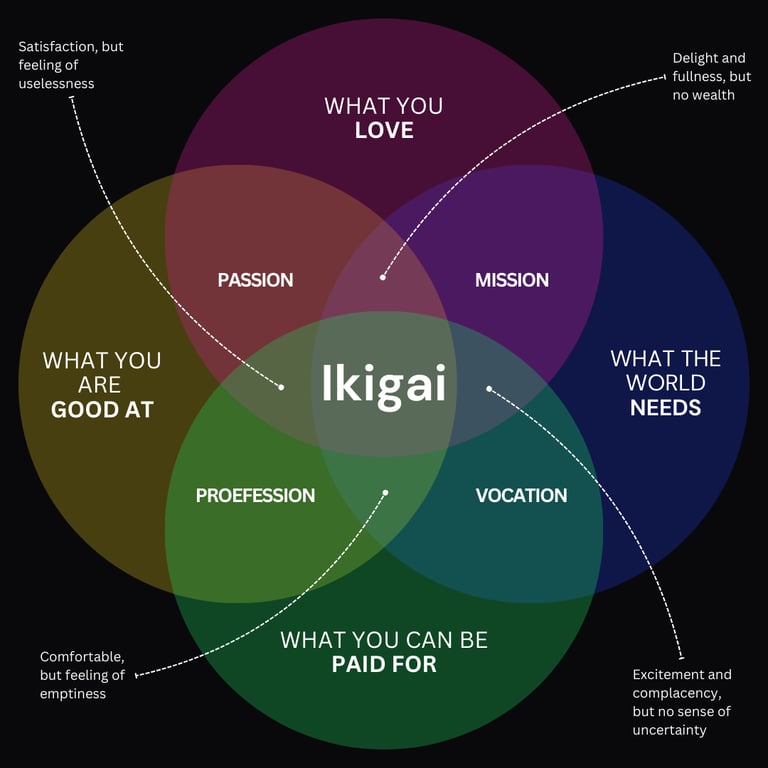
Let’s look at the 4 elements of Ikigai. It is represented by the intersection of these four essential elements:
- What You Love – The passions and activities that bring you joy, that you can lose yourself in, be distracted from everyday concerns and have a sense of peace.
- What You’re Good At – Your skills and natural talents. This might take some time to consider as what we are good at may not be immediately apparent!
- What the World Needs – Ways you can contribute to society or help others, which may be something small to you but can make a major impact in someone’s life.
- What You Can Be Paid For – Opportunities that align with your financial needs. Maybe that talent you have discovered about yourself or skills that you learnt at your job can be parlayed into something you like doing and can earn money from – doubling the benefit of fulfillment AND income from doing something you love.
When these elements converge, you uncover your Ikigai – a unique “sweet spot” that combines purpose with fulfillment.
How to Apply Ikigai to Your Daily Life
- Self-Reflection
The journey begins with introspection. Set aside quiet time to journal or meditate on each pillar. Ask yourself meaningful questions, such as: -
- What activities make me lose track of time?
- What are some activities I do at work or in my free time that I really like?
- What skills or knowledge do others seek my help with?
- What problems in the world resonate deeply with me?
- Take Incremental Steps
Ikigai doesn’t demand a life overhaul; small changes can make a big difference. For example, if writing brings you joy, dedicate 15 minutes daily to it. If helping others inspires you, consider volunteering at a local organization, and progressing from there. - Evolve With Time
Your Ikigai may change as your interests, skills, and life circumstances evolve. Remember, as human beings, we’re not meant to be static but always growing and changing with our life experiences. Embrace this process as part of the journey rather than focusing solely on the destination.
Finding Your Ikigai
Positivepsychology.com recommends writing the answers to these questions, then draw a blank Ikigai diagram with the 4 intersecting circles like the one above, and transfer a summary to it:
- Do what you love:
What did you enjoy doing as a child or in your early adult years?
What do you do now in your spare time that makes you happy? - Do what you are good at:
Do you know your strengths and skills? What are they?
What do people ask you to help them with? - Do something the world needs:
What and who inspires you?
What is a hole or need you can fill? - Do something you can be paid for:
What service or product could you sell (what would people pay you for)?
What would people value?
Take your time to review the completed diagram and consider what activity fits into the center part of the diagram, meeting each of the four circles’ criteria. So, start small, reflect deeply, and let your journey toward joy and purpose unfold. By embracing Ikigai, you can create a life that feels balanced, meaningful, and aligned with your true self.
Be well,
Juliet